– by Akash Pharande, Managing Director – Pharande Spaces
As the world gets increasingly torn by war and Indian retirees worriedly track the impact on their investments, one major area of concern should be housing – specifically, the costs involved, and whether the house is a good fit in the first place. If it is not, good money may be following bad in the worst possible times.
For decades, the Indian middle and upper-middle class have viewed the 'big bungalow' or the spacious 4 BHK apartment as the ultimate badge of success. In a culture where property is the primary symbol of wealth and social standing, the instinct has always been to upsize. However, there is a dawning realization among retirees and soon-to-be retirees that for the happiest homeowners, the most strategic move is not getting the biggest house possible.
Nor is it just right-sizing, which is just a fancy name for downsizing – which is depressing. It is 'right-fitting' – getting the right size AND type of home for the life they actually lead.
For senior Indian homebuyers and homeowners approaching or in retirement, the transition from 'more is better' to “what (not how much) do I really need?” is one of the most consequential financial and lifestyle decisions they will ever make.

The Illusion of the 'Dream Home'
For younger Indians, a home typically has some very specific concept parameters. It is a hub for raising children, if necessary housing extended family, proudly socializing, and storing artifacts accumulated over the years. It is a container for a life lived and yet to be lived, so it has to be big. To reuse the term – the bigger the better.
When Indian homebuyers sell their homes in a tier-1 city like Mumbai to relocate to a tier-2 city like Pune, Kochi or Coimbatore, the temptation is to use the price differential to buy a bigger home than the previous one. Size is often the primary criterion, with not much thought given to how well the space and location will serve in later years.
In later years, as children often move abroad for education or migrate to different cities for work, the functions of the home change. It is not unusual to find elderly Indian homeowners living in outsized, badly-located storage spaces dedicated to a life that they once had – or hoped to have – and no longer have now.
For older people with an empty nest, an oversized home in the wrong area becomes a source of depression and regret. Depression because large empty spaces echo the past far more efficiently than smaller ones, and regret because the cost – both financially and in terms of effort – are no longer justified.
There may be a lingering hope that the flown birds, so to speak, may return to the nest. And indeed, that can happen, especially in these times of global socio-economic upheaval where many NRIs have to return to India and may need the space. But this assumes that the returning migratory birds will either have no option other than to live with their parents, or that they would prefer to.
This is a big assumption, and may even be vindicated in some cases. But the larger trend is that returning expatriate professionals are more interested in the nuclear family format, and will want to live separately. Also, younger Indians value convenience and being able to entertain themselves and their family. A large flat can accommodate the body, but not the heart and soul.
Too often, managing a large home becomes the single focus of a retired Indian couple's life. It feels 'productive', since they are working hard at tangible tasks, but it is actually just the life of a hamster in a wheel. They are running energetically to nowhere, spending their precious silver years and remaining bandwidth as perennial housekeepers.
The Township Advantage
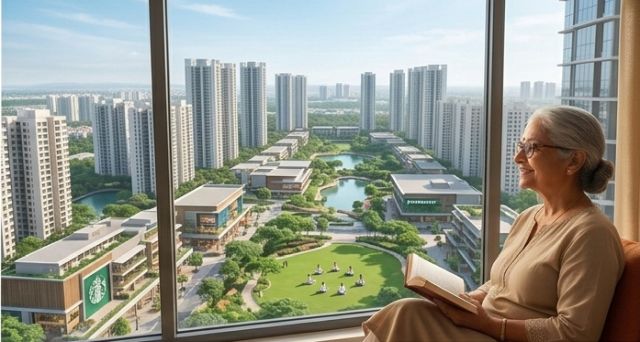
The financial logic of a tool that fits the job — in this case, a home that actually serves its occupants — is particularly relevant in the Indian context. Inflation eats into everything, from the value of one's savings to the cost of living. A large, isolated home consumes as many resources as a well-located one, without delivering a better life. This is where the integrated township emerges as the ultimate 'right-fitting' solution for ageing Indians.
In a regular residential tower or villa, you must manage the property but the world outside is often chaotic, inaccessible, or lonely. A township flips the script. It is not just about the square footage of your apartment but about the extended living room that starts the moment you step out of your front door.
From Maintenance Trap to Managed Lifestyle
In a township, the burden of maintaining the structure is professionalized and shared. Instead of haggling with individual contractors for plumbing or security, homeowners enjoy a seamless ecosystem. This shift allows retirees to stop being property managers and start being real residents.
The efficiency of a township means you can opt for a 'right-fitted' 2 or 3 BHK that is easier to clean, manage and navigate even as you enjoy the luxury of dedicated green open spaces, landscaped gardens, and fully-equipped clubhouses.
Social Touch Points
The greatest risk of the 'big house' is the 'beautiful bubble' effect. Yes, it is big, but the life that ageing inhabitants live inside becomes very small. There is no world to step into. Townships solve this because they are fundamentally 'social architecture'.
When you live in a township, you don't have to schedule a visit to see a friend. You are likely to meet them at the clubhouse or supermarket within the premises, on the walking track, or at the cafe. For the Indian senior, these small interactions are the literal heartbeat of a happy retirement.
Townships provide a safe, pedestrian-friendly environment where 'going out' does not need a car or driver. It offers the independence of a private home with the safety net of a village.
Future-Proofing for the 'Returning Migratory Birds'
The concern that children might return from abroad and need space is valid, but the township model addresses this more realistically than a giant, empty villa. If children and their nuclear families do return, they are rarely looking for a spare bedroom in a silent house. They are often returning from a developed country, and want a real lifestyle.
A township offers amenities like swimming pools, gyms, play areas, and high-speed connectivity that every modern NRI professional takes for granted. It allows for 'proximity without pressure.' Many families find that 'right-fitting' involves owning two smaller units within the same township rather than one giant, awkward bungalow. This preserves the privacy of both generations while ensuring they are only a five-minute walk apart.
The Luxury of Optionality
Ultimately, 'right-fitting' into a township is a strategic allocation of resources. By not over-investing in dead square footage that only serves to store old furniture, homeowners unlock capital and time.
The real luxury in the silver years is optionality — the freedom to travel to see grandchildren, to join a hobby club, or to simply enjoy a sunset in a park that you do not have to mow yourself. A big house demands that you serve it, while a township serves you.
For the modern Indian homeowner, the dream is no longer just about the height of the gate or the size of the floor plan. It is about finding a fit that is snug enough for comfort, yet expansive enough for a community. If you are over 50, it is high time to stop thinking about wider-apart walls and ceilings, start optimizing the life you live within them.
About the author:

Akash Pharande is Managing Director of Pharande Spaces, a leading real estate construction and development firm famous for its township projects in Greater Pune and beyond. Pharande Promoters & Builders, the flagship company of Pharande Spaces and an ISO 9001-2000 certified company, is a pioneer of townships in the region.